
Q&A with Rachid Pafadnam
Summer Series. Promoting institutional dialogue for better policies
Rachid Pafadnam, a Ph.D. candidate in economics at CERDI, will defend his PhD thesis in October, soon after our department's jubilee celebrations.
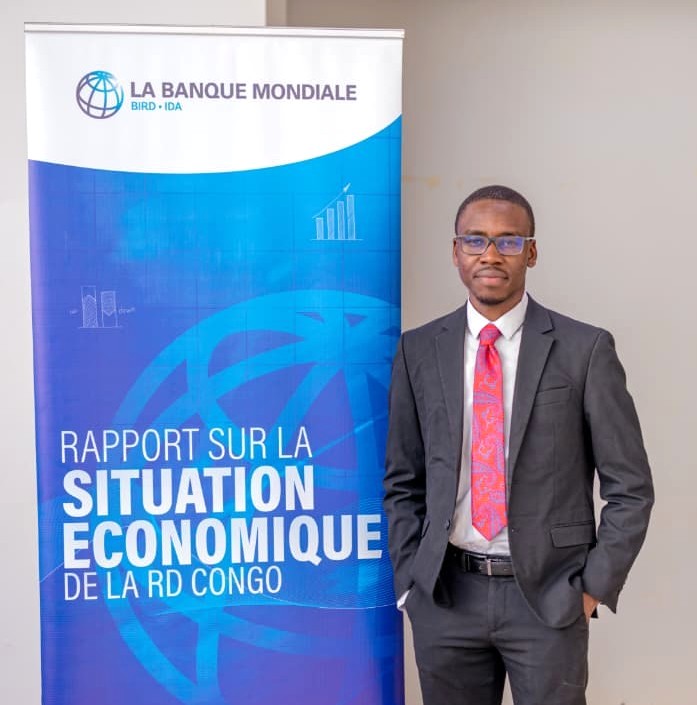
He was selected from among many candidates for the World Bank Group student-researcher program in 2026. He answers our questions about his academic journey and this recent experience.
Can you tell us about your academic background?
I am finishing my Ph.D. studies at CERDI under the supervision of Samuel Guérineau. I focused my research on governance in natural resource management, development financing, and public debt dynamics in developing countries. Before joining the department, I pursued my master's studies at the School of Economics of the Universite Clermont Auvergne (UCA), where I earned a dual master's degree in development economics, with specializations in economic analysis and project analysis. I obtained my bachelor's degree in economic analysis from the Université Aube Nouvelle (U-AUBEN) in Ouagadougou, Burkina Faso.
My thesis journey has been enriched by several professional experiences that have allowed me to deepen my research areas and work with experts and stakeholders on crucial economic issues. In 2024, I was selected for the International Monetary Fund (IMF) internship program. Last year, I also participated in the "political economy of taxation" project led by the United Nations University World Institute for Development Economics Research (UNU-WIDER). Until recently, I was a Fellow at the World Bank.
What did you do during your time at the World Bank?
It was an honor for me to be selected as a Fellow and to join the Bank's office in the Democratic Republic of the Congo, headed by Albert Zeufack, one of my eminent predecessors at CERDI. I was attached to the Fiscal Policy and Growth unit, managed by Rafael Munoz Moreno. I had the privilege of joining a fantastic team and working alongside Cedric Deguenonvo, Jean-Pascal Nganou, Moise Tshimenga Tshibangu, and Jeannine Nkakala Kashosi.
I have contributed to writing two Economic Updates on the DRC, which analyze the country's macroeconomic situation and the structural reforms needed to stimulate development (the first report is available online). I also had the opportunity to contribute to the drafting of research papers.
Being on the field allowed me to get involved in managing some of the World Bank-funded projects. I participated in meetings between the Bank's and ministries' representatives. This unique experience enabled me to develop my expertise in policy dialogue. As a junior researcher, I was glad to contribute actively to the research promotion activities initiated by the World Bank in collaboration with Congolese universities.
Working across multiple areas of activity was intense and rewarding.
Why did you choose the CERDI?
I knew CERDI would be a stimulating scientific environment to develop my research, thanks to the many insightful discussions with professors, doctoral students, and visiting researchers. I was able to challenge my ideas, refine my methods, and gain perspective on some of my work. I felt free to discuss my work. I was glad to receive constructive feedback and gradually built my researcher profile.
Here, I developed in-depth expertise in development economics. The laboratory also provided me with a setting conducive to expanding my scientific network, particularly through seminars and conferences. Beyond the training and knowledge that I have acquired, this recent experience at the World Bank has been hugely rewarding. It has reinforced my wish to continue my career in this field, particularly to contribute to the implementation of public policies that improve people's living conditions.
I am really glad to complete my doctorate in 2026, the year the CERDI celebrates its 50th anniversary.
Follow him on LinkedIn
References
Laws, A., Lemaire, T., Pafadnam, R., Spatafora, N., & Khandelwal, K. (2025). Breaking the trend : Debt stabilization in sub-saharan africa. IMF Notes, 2025(001), 1. https://doi.org/10.5089/9798229008679.068.
Laws, A., Lemaire, T., Pafadnam, R., Spatafora, N., & Khandelwal, K. Issue 001 : Enrayer la tendance: stabilisation de la dette en Afrique subsaharienne (2025). (IMF Notes, 2025(001). https://doi.org/10.5089/9798229008686.068.
Pafadnam, N. A. R. (2024). How does implementing the Extractive Industries Transparency Initiative (Eiti) affect economic growth? Evidence from developing countries. European Journal of Political Economy, 85, 102584. https://doi.org/10.1016/j.ejpoleco.2024.102584.
Bouterige, Yannick, Pafadnam, Neerbewende Abdoul Rachid. The Extractive Industries Transparency Initiative (EITI): A mine of information to be exploited? FERDI Working Papers. 313. 2024. https://hal.science/hal-04493418v1.
Bouterige, Yannick, Pafadnam, Neerbewende Abdoul Rachid. L’Initiative pour la Transparence dans les Industries Extractives (ITIE) : une mine d’informations à exploiter ? FERDI. Document de travail. 313. 2023. https://hal.science/hal-03937266v1.