
Q&A with Habibou Ibrahim Kassoum
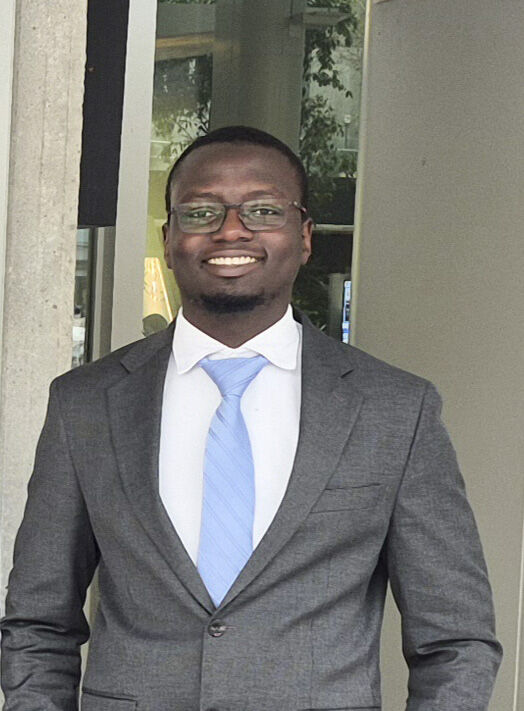
Summer series. Habibou Ibrahim Kassoum explores microeconomic questions
Habibou Ibrahim Kassoum is a PhD candidate in economics at our laboratory. A microeconomist, his main interest is public policy aimed at the most vulnerable. Here he answers our questions about his recent experience at the World Bank, where he was selected from a large pool of applicants for the World Bank's student-researcher programme.
Can you tell us about your academic background?
My thesis is supervised by Pascale Phélinas and Jordan Loper. It looks at poverty, undernutrition and, more broadly, social protection in fragile and conflict-affected countries. I chose CERDI, and I have grown here both professionally and personally. The lab's small size is a real advantage: I can talk to everyone, and people make themselves available.
Before joining CERDI for my doctorate, I trained as a statistical engineer at ENSAE-Dakar, then earned an engineering degree in data science and applied economics at ENSAI-Rennes, as well as a research master's in economics at AMSE. I also completed the DEDP MicroMasters, an MIT certificate in data analysis, economics and development policy designed in part by Nobel laureates Esther Duflo and Abhijit Banerjee, which allowed me to strengthen those skills.
What did you work on during your time at the World Bank?
I was delighted to be selected for the programme this year, especially since I had already interned with the team I joined: the Poverty and Equity team for Eastern and Southern Africa. I had the chance to work alongside Lina Cardona Sosa, Kristina Vaughan and Mohamed Boly, and with the wider team, in a stimulating and collaborative environment.
Last year, I spent several months at the Africa Gender Innovation Lab working with Julia Vaillant and Kelsey Wright. I took part in the evaluation of a social protection programme designed to reduce intimate partner violence. I also wrote a research paper on the topic, which I had the opportunity to present to the team.
This year, I continued working on similar questions in preparation for the Malawi Poverty and Equity Assessment. I also contributed to the analysis of living conditions among refugees in Uganda, and to the update of Malawi's national poverty line. This work gives decision-makers accurate, essential evidence for adjusting public policy.
What comes next?
In the autumn, I will take up a teaching and research post (ATER) at the UCA School of Economics. I hope to finish and defend my thesis in early 2027. I am very glad to have done my PhD at CERDI: you can talk to every member of the team, and the researchers make themselves available and give us feedback on our work.
I have been fortunate to work as a consultant for several institutions, which has helped me develop my skills in applied research. I have built solid knowledge of individual welfare measurement and of microsimulation techniques — that is, changing elements of a policy and observing the results. It is a useful method for testing policies and assessing their impact. I want to continue my career in this field, which uses rigorous data to design more effective poverty reduction policies.
Want to know more? Visit Ibrahim Kassoum Habibou's website.