
Q&A with Arouna Zorome
Summer Series. Arouna, an economist with expertise in trade
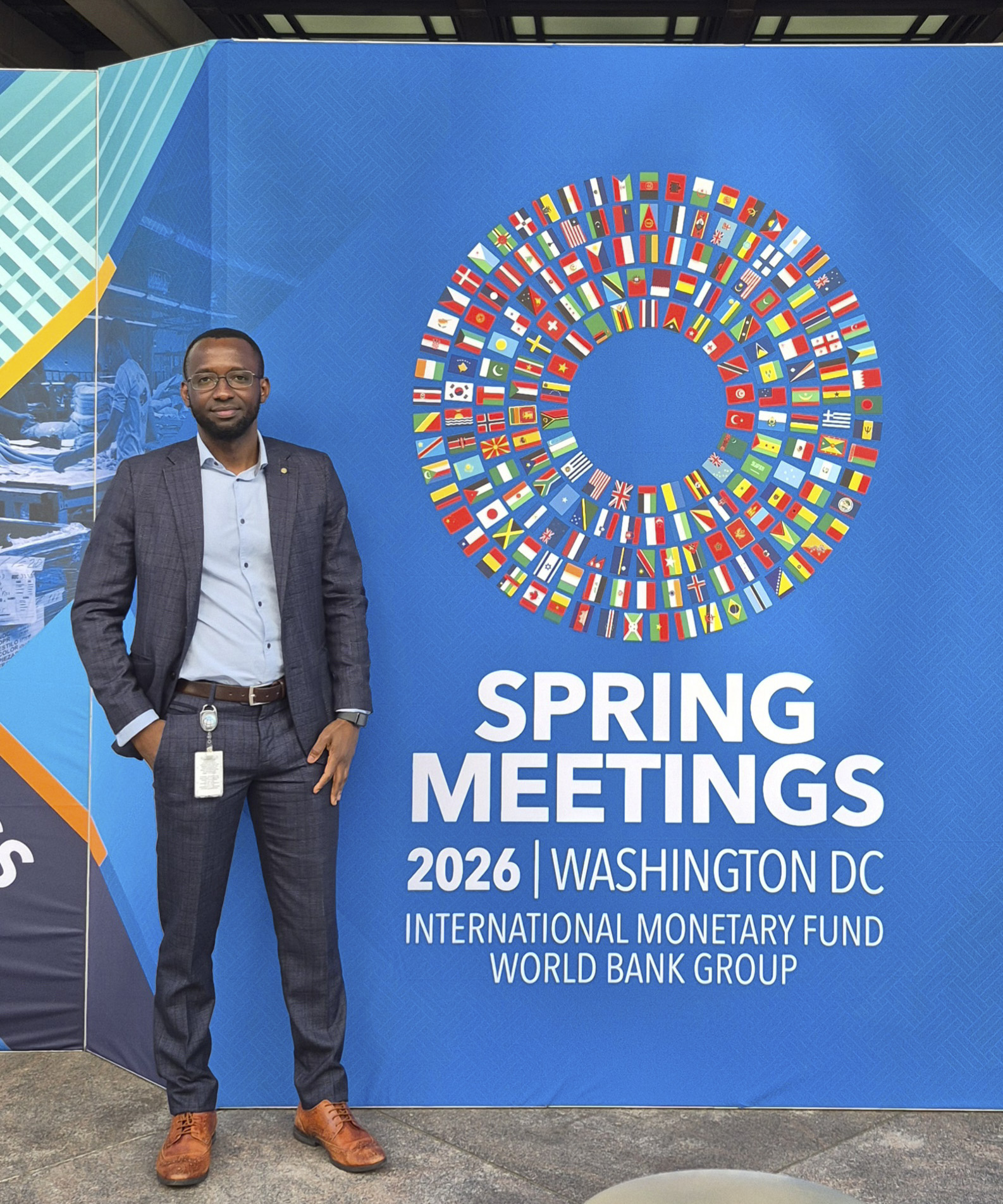
Arouna Zorome is a PhD candidate in Economics in our department at the Université Clermont Auvergne. His research explores the links between trade globalization and the macroeconomic costs of climate change in developing and emerging economies. In 2026, he was selected from among thousands of candidates to join the World Bank Group's Africa Fellowship Program. He continues to collaborate with the Bank's teams as a consultant.
He looks back with us on his academic journey, his experience as a researcher, and what CERDI has brought him.
Can you tell us more about your studies?
After a BSc in Applied Economics at Université Péléforo Gon Coulibaly in Korhogo, Côte d’Ivoire, I joined the School of Economics of the Université Clermont Auvergne to pursue a "Magistère" in Development Economics. This selective and demanding program allowed me to earn two master’s degrees, in Development Economics (research track) and Development Project Management (professional track). This dual training gave me both a solid foundation in economic research and a more applied approach to development issues.
I then stayed on to pursue a PhD in Economics at CERDI, funded by the Chair of Industrial Economics of Emerging Africa, jointly held by UM6P and Mines Paris – PSL. My thesis examines the links between trade globalization and the macroeconomic costs of climate change — in particular, how climate shocks spread from one country to another through trade, co-supervised by Michael Goujon (CERDI, UCA) and Ahmed Tritah (Université de Poitiers, Chaire IEEA).
What were you doing during your fellowship at the WBG?
In January, I joined the World Bank's Economic Policy unit as part of the World Bank Group Africa Fellowship. I worked within the team covering macroeconomics and trade in the CEMAC region, alongside Robert Utz and Aleksandar Stojanov, contributing to several macroeconomic and trade diagnostics at both regional and national levels. My work mainly focused on analyzing trade structures, economic performance, and tariff policies to identify the main obstacles to trade and the reforms needed to address them. I also had the chance to join the Central African Republic country team on a fieldwork mission to Bangui, taking part in consultations ahead of the Growth and Jobs report.
This experience complements the one I gained at UNCTAD in 2025, within the Trade Facilitation section, where I contributed to the Review of Maritime Transport 2025 with empirical analyses on the role of digitalization in maritime trade performance in developing countries. More broadly, it connects to my core research interests in international trade and development in developing countries.
If you were to mention one particular comparative advantage to do a PhD here, what would you say?
I would say CERDI's main advantage is the perfect balance between rigorous academic training, a strong empirical culture, and a very concrete engagement with development challenges — all of which come with real connections to international institutions.
On a personal level, CERDI gave me, above all, a solid foundation in development economics and strong quantitative skills. It's an environment where you're constantly pushed to go beyond simply describing an economic problem — to formulate a precise research question, build a rigorous methodology, and produce results that genuinely contribute to the economic debate.
I have valued every moment spent in this lab alongside excellent researchers and development practitioners, and I look forward to celebrating the 50th anniversary.
Follow him on LinkedIn